LEAD WITH LOVE: ORCHESTRATING “LALOVAVI” (KEVIN DAY & TIFARA BROWN)

“When you are tested, lead with love.” These are the words that Dinah tells to Persephone in the climactic moments of Act 1 in Lalovavi, an Afrofuturist science fiction adventure opera my friend Kevin Day has created along with librettist Tifara Brown. Persephone, the daughter of the ruthless Titan, has just been told she holds the key to eternal life and that her father will stop at nothing to acquire it. Dinah, Persephone’s nursemaid, helps her escape beyond the walls of Atlas. The first hour of world-building, exposition, and character development comprised in Act 1 all leads to this moment, setting the stage for Persephone’s epic journey through this fantastic and wondrous world.
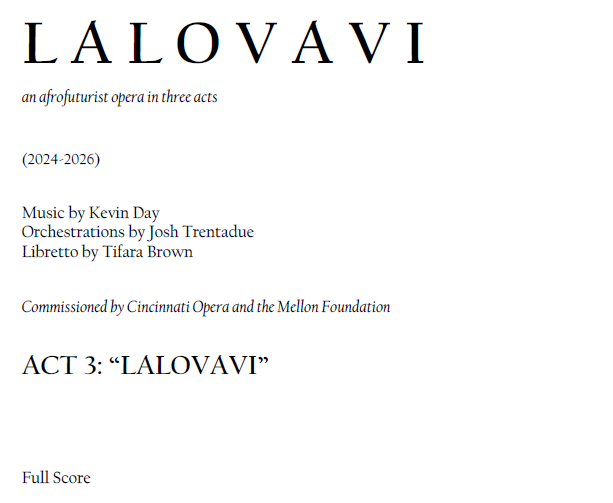
Lalovavi received its world premiere last week at the Cincinnati Opera, the culmination of a multi-year journey that Kevin had undertaken in writing the jazz-influenced, cinematic score for an inherently cinematic opera. For me, it is the culmination of a roughly two-year journey with the once-in-a-lifetime opportunity of working with Kevin to orchestrate his music and prepare the performance materials for the production. It was, for all intents and purposes, a dream come true in a medium I never expected to work in, but have learned so much from nonetheless.
When I was asked to join this project, I was immediately enraptured by the concept. I loved the memorable story that Kevin and Tifara had created. I loved Persephone’s journey; the subtle character moments that give each scene more power and meaning; the recitatives of Act 1; the dialogue between Persephone and Lucian in Act 2; the arias and dream sequence in Act 2; and the resolution to the story in Act 3. It’s an opera that’s a celebration of Black joy and creativity, as well as a love letter and tribute to the science fiction genre. It depicts relatable, universal, timeless themes and ideas within an extraordinary futuristic world, guided by a traditionally symphonic orchestra. The thought was not lost on me that, coincidentally, a certain science fiction film made almost 50 years ago took a very similar approach in using traditional, symphonic music to connect audiences with its characters and thematic ideas within a fantastic universe.
And so my research in preparing for this crucial task of co-orchestrating roughly 150 minutes of music was not just focused on opera, from Mozart to Corigliano and everything in between. I also studied the work of a number of film orchestrators, including Herbert W. Spencer, Angela Morley, Alexander Courage, John Neufeld, Conrad Pope, and so on. I listened to a wide range of film scores from the 1970’s to the present day to suggest ideas to Kevin on how certain moments within Lalovavi could be dramatically enhanced. Intricate trumpet and tambourine rhythms create John Powell-like rhythmic motion as the Luminous Forest beautifully comes to life. Flourishing harp and strings akin to James Horner’s most magical cues occurs when Persephone summons her power for the first time in an emotional dream sequence. Cascading, musical falls - much like some of the dramatic moments of Alan Menken’s early Disney scores - suddenly happen when Persephone and Lucian confront a wild beast during their journey. Driving, punctual drums & percussive energy briefly hearken back to Jerry Goldsmith’s most rhythmic music during the final battle in Act 3. Finally, the orchestration of Lalovavi from start to finish is imbued with all of the reverence, soaring emotions, heightened drama, and unique colors, textures, & sounds that has made the music of John Williams so memorable in so many different ways.
That last point in particular informed the final months of my co-orchestration work, particularly for Act 3. Around the same time, Tim Grieving’s biography John Williams: A Composer’s Life had just been published (and, of course, if you know me well, you’ll know I highly recommend it). Part of Grieving’s book dives into Williams’s interest in poetry and mythology, particularly the work of Robert Graves and Carl Jung, and how he would develop a philosophy in perceiving music to be both spiritual and psychological, a connection or communion of sorts to the past from the present. It’s this philosophy that I believe is one vitally essential ingredient to how Williams’s music compels one so strongly to connect, or resonate, with a character, an emotion, an idea, and so on, from the aspirational heroism and emotional suspense of None But the Brave to the assertions within Disclosure Day that humanity should listen to each other more.
In Lalovavi, Kevin had already created such dramatically and emotionally memorable, powerful, and resonant themes, motives, and arias to bring Tifara’s fantastic libretto to life. In my own researching and reading such works as Williams has done, it’s also not lost on me that perhaps my orchestration work for this opera, intentionally or not, had been influenced by some of these philosophies to an extent. Nevertheless, this is a Kevin Day work through and through, enhanced as a purely cinematic experience for a purely cinematic opera.
Lalovavi is a story celebrating Black joy and creativity. It is a powerful, transcendent tale of love, hope, resilience, and spirit. It is a dramatic exclamation point of excellence in the world of opera. And, it is a compellingly beautiful story I am so blessed to have been a small part of.
Thank you to all of the members of the production team at the Cincinnati Opera who entrusted me with preparing these performance materials for this premiere. Thank you especially to Kevin Miller and Kelly Kuo for all of your invaluable insight and guidance throughout the workshops and revision process over the past year. Thank you to Evans Mirageas and Morris Robinson for making all of this possible.
And, finally, thank you, Kevin, for asking me to be a part of this journey and taking a chance in me to help you realize your dream. I am so grateful to know you and am so proud of you.